TAMU-CC Researchers Urge Caution to Avoid New COVID-19 Surge this Fall

By Darrell J. Pehr | Published: October 25, 2020

2020_pandemic-report-story_web-story_800x500.jpg

CORPUS CHRISTI, Texas – Researchers at Texas A&M University-Corpus Christi are urging everyone to remain vigilant and continue to wear face coverings, maintain social distance, and avoid large indoor gatherings as the number of COVID-19 cases rises across some parts of Texas.

“New cases remain low here, but are increasing significantly in Northwest Texas,” said Dr. Chris Bird, Associate Professor of Biology at Texas A&M-Corpus Christi. “As people gather more inside and the weather cools, face coverings and social distancing become increasingly important tools to combat a COVID-19 outbreak.”

Bird noted that the Coastal Bend is now seeing the lowest rate of new cases per capita compared to all other areas of Texas, a substantial improvement over past months. Hospitalizations in the Coastal Bend also have dropped as well as the number of people in intensive care units, however the decrease in hospitalizations has slowed and there are still more people in ICUs than before the initial outbreak in July.

One model the researchers follow shows that the transmission rate has slightly increased, which has researchers concerned, especially with the approach of holiday activities, such as Halloween and Dia de los Muertos.

“With a renewed commitment to taking simple precautions, we can make a big difference in how the Coastal Bend is impacted this fall and winter,” said Dr. Philippe Tissot, Interim Director of the Conrad Blucher Institute at A&M-Corpus Christi. “Much of what happens next is up to us. We don’t need to go through another outbreak.”

The researchers, part of a special COVID-19 task force, have projected what would happen if the transmission rate increases to 2.0, meaning each infected person spreads the disease to two other people. This scenario also assumes that the transmission rate changes back to 0.9 when 15% or more inpatients in Coastal Bend hospitals are COVID positive for at least seven days, as measures would be rolled back.

If a new surge starts, reacting quickly will considerably limit hospitalizations and casualties. The number of COVID-19 patients for this second scenario would increase over the next several weeks, reaching a peak in early November just below the peak in cases reached during the July surge. Total cases for the remainder of the year would be 12,387, significantly higher than if the transmission rate remains low.

Bird and the joint task force are analyzing the latest case data and have detected a bottoming of the downward trend around Oct. 10 and an increase since then. The task force will share its latest analyses – and whether this uptrend in cases is confirmed – at its weekly update to the Coastal Bend.

The task force is preparing in-depth reports and public presentations each week for the City of Corpus Christi and Nueces County that model the course of the virus across the Coastal Bend. The updates are presented at 5 p.m. Tuesdays.

The team’s presentations and findings can be seen on a special dashboard: https://www.conradblucherinstitute.org/covid19.

TAMU-CC Researchers Map Out How COVID-19 May Look in Future

2020_pandemic-report-story_web-story_800x500.jpg

CORPUS CHRISTI, Texas – With many Texas businesses now allowed to increase occupancy to 75% effective Sept. 21, researchers at Texas A&M University-Corpus Christi have prepared scenarios that show how the spread of COVID-19 could change over the coming weeks in the Coastal Bend.

The special COVID-19 research team generated two possible tracks for the disease, taking into consideration the relaxed occupancy limits for retail businesses, restaurants, gyms, offices, and others; the coming seasonal change in weather; and how well residents of the Coastal Bend will continue to adhere to social distancing, wearing masks, and other precautions. The scenarios are focused on the level of hospitalizations in area hospitals and follow the current transmission rate, as well as a possible increased rate.

“Basically, we’re having a small number of cases, our regulations have changed, and a lot of people want to know what might happen,” said Dr. Chris Bird, Associate Professor of Biology at Texas A&M-Corpus Christi. Bird presented the information during a regular weekly update Sept. 29 by city and county officials.

The first scenario, a continuation of the rate of transmission continuously used since mid-July, shows hospitalizations continuing to slowly decrease from a peak of cases in late July. Using a transmission rate of 0.9, meaning one infected person infects less than one other person, the model predicts a slow decline through the rest of the year when cases will be near zero. Total cases for the remainder of the year are projected at 421.

The second scenario shows what could happen if the transmission rate increases to 2.0, meaning each infected person spreads the disease to two other people. The second scenario also assumes that the transmission rate changes back to 0.9 when 15% or more inpatients in our Coastal Bend hospitals are COVID positive for at least seven days, as measures would be rolled back. If a new surge starts, reacting quickly will considerably limit hospitalizations and casualties. The number of COVID-19 patients for this second scenario would increase over the next several weeks, reaching a peak in early November just below the peak in cases reached during the July surge. Total cases for the remainder of the year would be 12,387.

The researchers emphasized that residents of the Coastal Bend can reduce or limit a new surge in cases depending on how well they follow precautions.

“It’s important for the community to know we could go through it again,” said Dr. Philippe Tissot, Interim Director of the Conrad Blucher Institute at A&M-Corpus Christi.

Bird agreed, noting that a continued commitment to taking precautions, such as wearing face masks, will be vital to maintaining the trend downward.

The researchers urge people to follow precautions carefully, such as social distancing, hand-washing, wearing face coverings, staying at home, and not gathering in groups in an effort to slow the spread of COVID-19.

Bird and other members of the task force are preparing in-depth reports and public presentations each week for the City of Corpus Christi and Nueces County that model the course of the virus across the Coastal Bend. The updates are presented at 5 p.m. Tuesdays, except for next week when the update will be presented at 5 p.m. Wednesday, Oct. 7.

The team’s presentations and findings can be seen on a special dashboard: https://www.conradblucherinstitute.org/covid19.

Bell Library Awarded $25K Grant to Digitize Blucher Family Papers

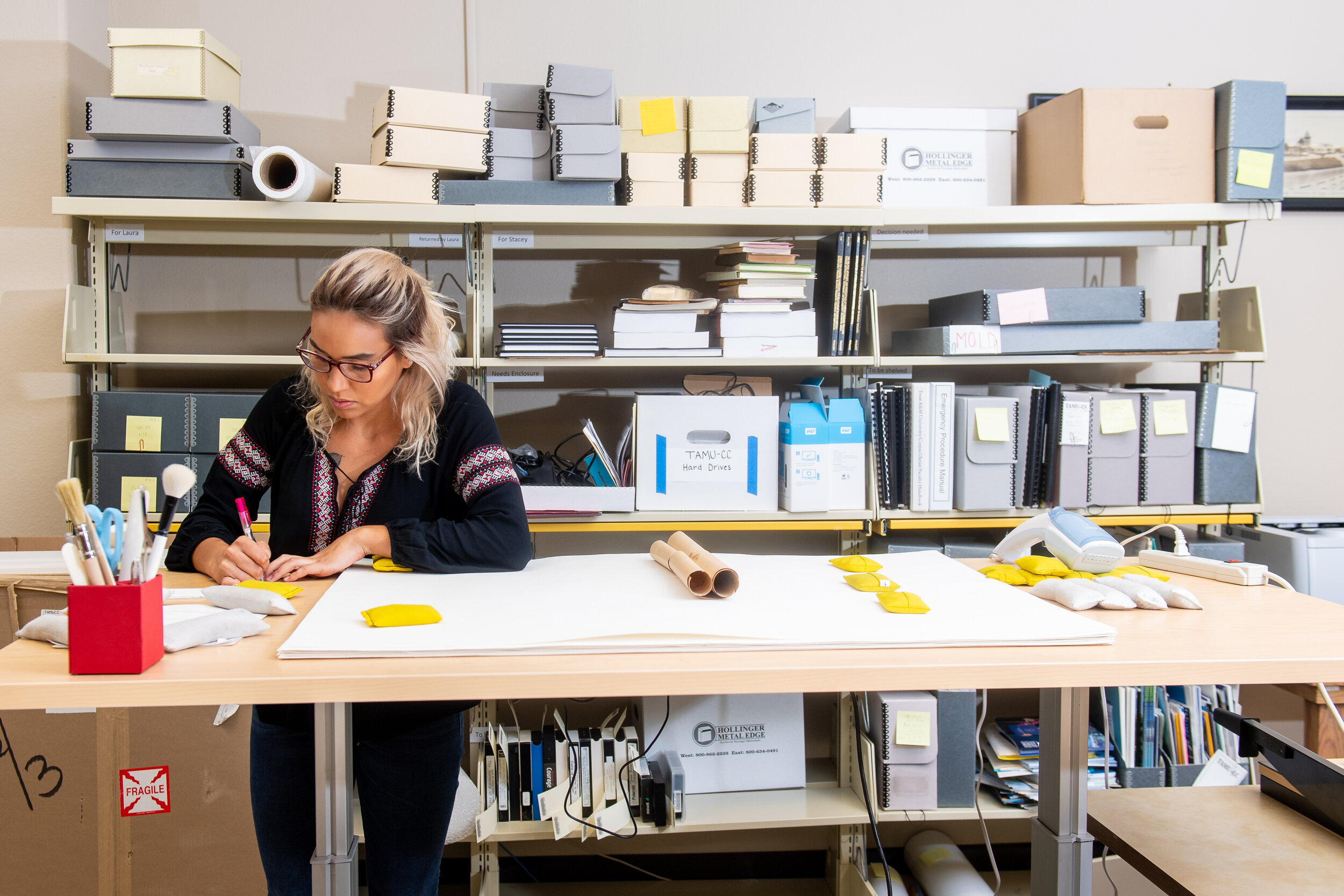
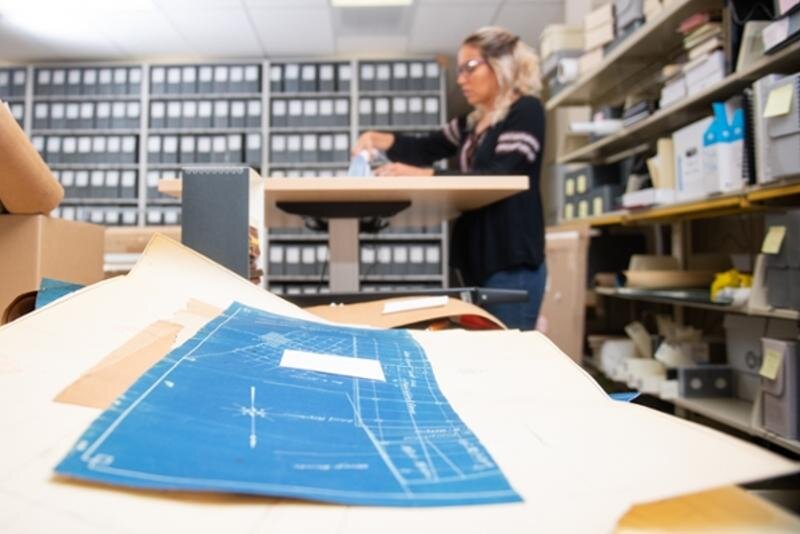
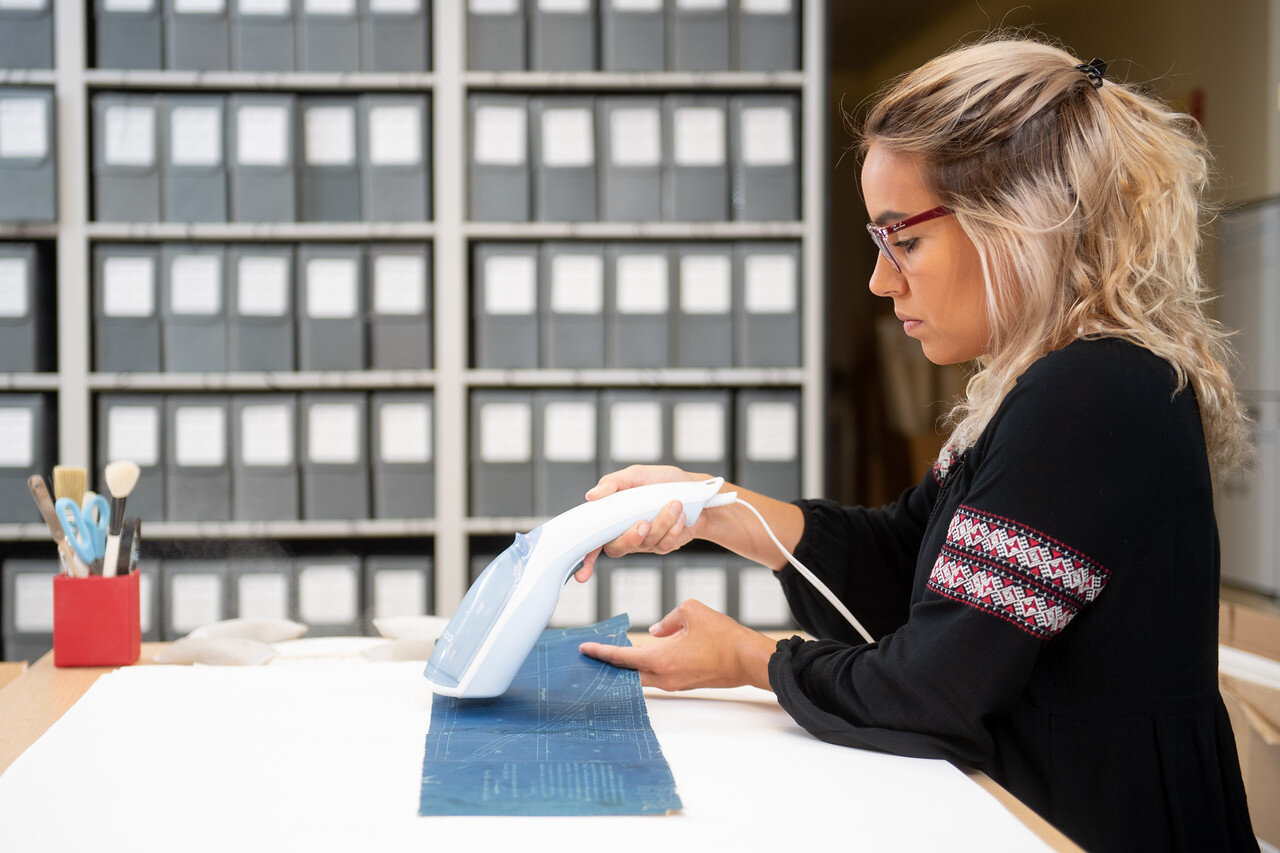
CORPUS CHRISTI, Texas – The Texas State Library & Archives Commission (TSLAC) recently awarded funding to The Special Collections and Archives Department at Mary and Jeff Bell Library at Texas A&M University-Corpus Christi under its Texas Reads grant program. Bell Library began work on a project to survey, process and create catalog records for the Charles F.H. von Blucher Family Papers on Sept. 1. Patrons will be able to access the papers via the internet upon completion of the project.     

The award provides $25,000 to hire a part-time graduate assistant (GA) who will work 17 hours a week between Sept. 1, 2020 and Aug. 31, 2021 on the Family Papers project, which consists of 149 linear feet of paperwork. The collection represents the history and contributions of three generations of a prominent German-American family from 1840 to 1940, according to Lori Atkins, the principal investigator who wrote the grant with Processing Archivist Eric Christensen and Library Specialist II Phebe Leach.

“The Blucher Collection is divided into two parts: the maps in the Conrad Blucher Surveying Collection (CBSC) and the family’s historical papers in the Charles F.H. von Blucher Family Papers (Family Papers),” Atkins said. “Baron Anton Felix Hans von Blücher was a German immigrant who came to Corpus Christi tin the 1840s; he served as Nueces County’s first elected surveyor. His son Charles F.H. von Blucher and grandson Conrad M. Blucher followed him in this position.” 

Work on the Family Papers project will be divided into three phases.

  • Phase I: The GA will survey the existing collection to gauge the current state and preservation issues of the collection.

  • Phase II: The GA will prepare a processing plan that outlines the proposed hierarchy of the collection, preservation activities and the level cataloging needed.

  • Phase III: The GA will process the papers and create cataloging records for the collection and write a Finding Aid, or guide that describes the contents of a collection, that will be loaded onto three portals.

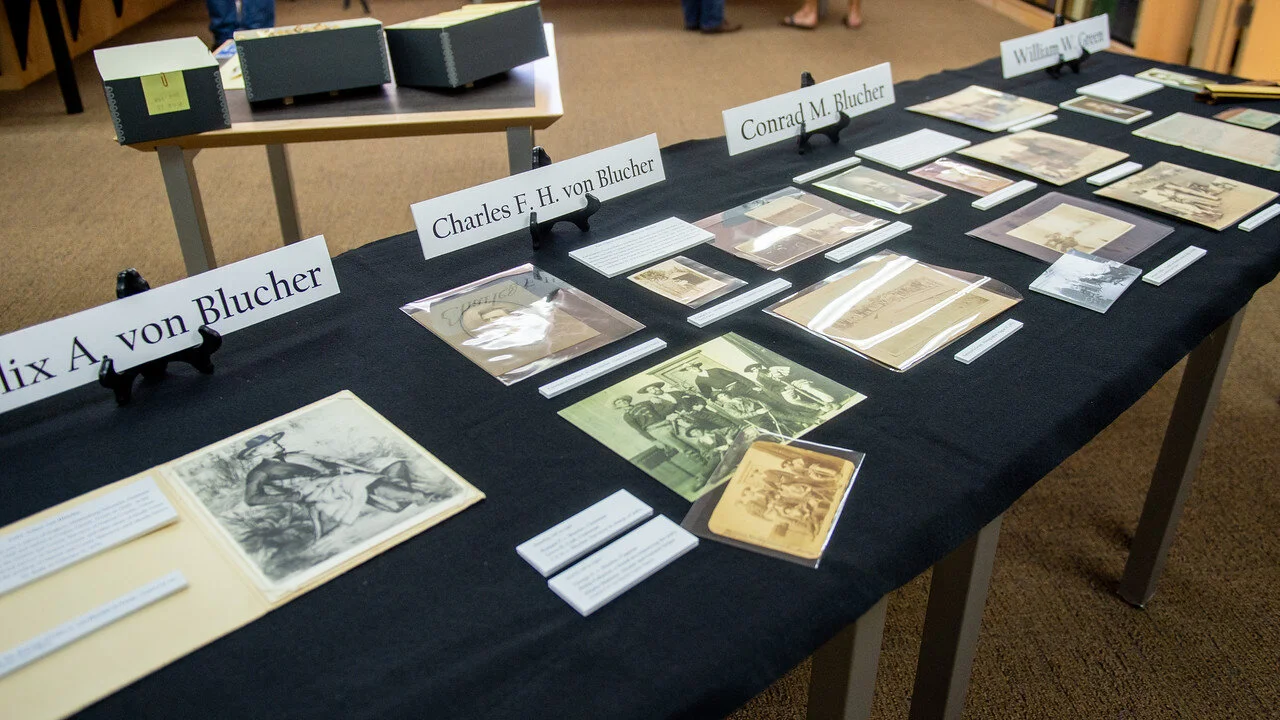
The Family Papers include a broad range of items, including historic photographs dating to 1860, family trees and genealogy of the Blucher family, personal and business correspondence, diaries, financial, legal documents, and personal drawings, Atkins said.   

“The letters of Maria von Blucher are included in these files. She was a young German bride in 1849 who came with Felix von Blucher to Corpus Christi Bay to establish their home in the new frontier town. For thirty years, she wrote letters home describing her life, the living conditions, droughts, Indian and bandit raids, the American Civil War, and the development of Corpus Christi,” Atkins said. “These letters open a window into a time gone by and the building of a city.”

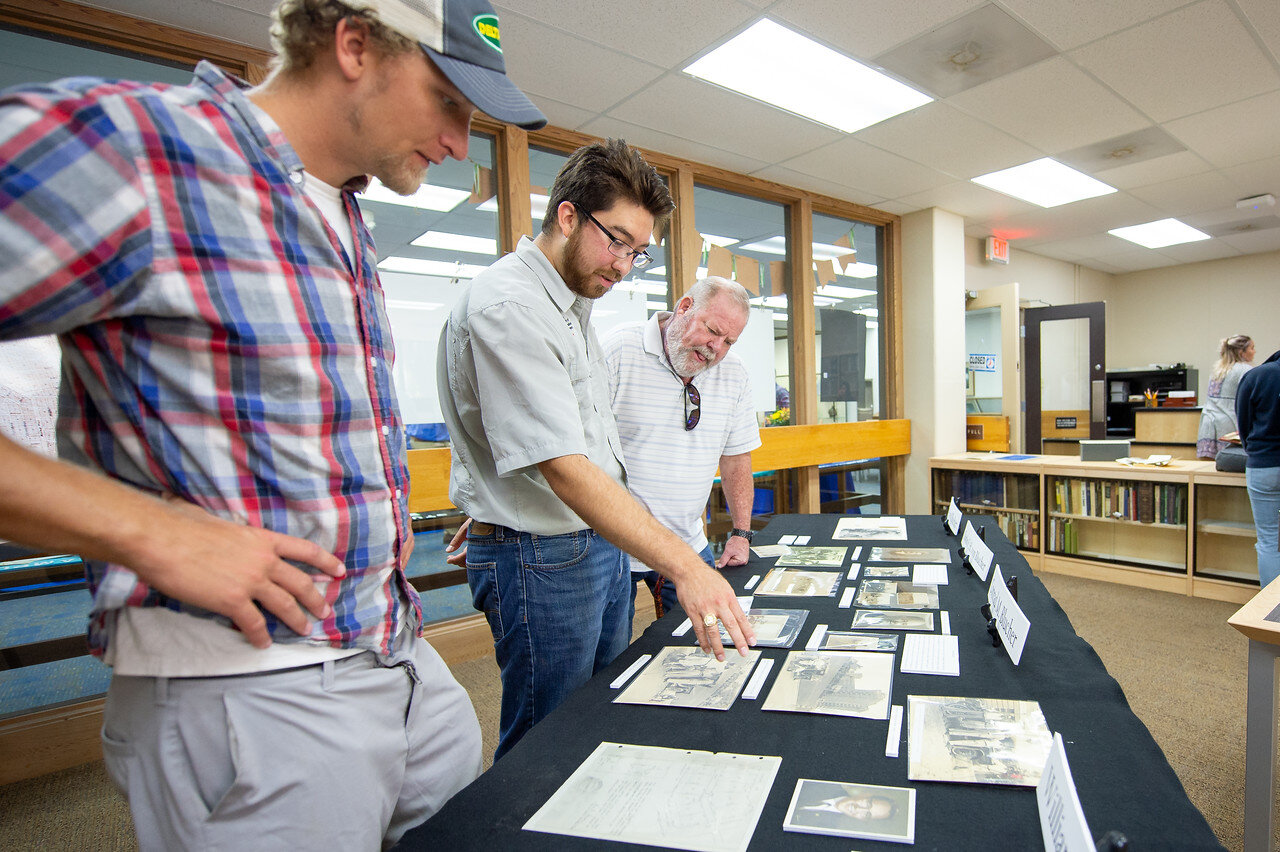
Atkins said while the von Blucher Family Papers are available to the public today, researchers must visit the Special Collections Reading Room at Bell Library to read them. The goal of the project is to digitize and upload all photographs, slides, and Maria von Blucher’s letters to the library’s repository website to make the papers available to all via the internet. The full scope of the project will take two years, she said, and the team plans to reapply for the grant next fiscal year.

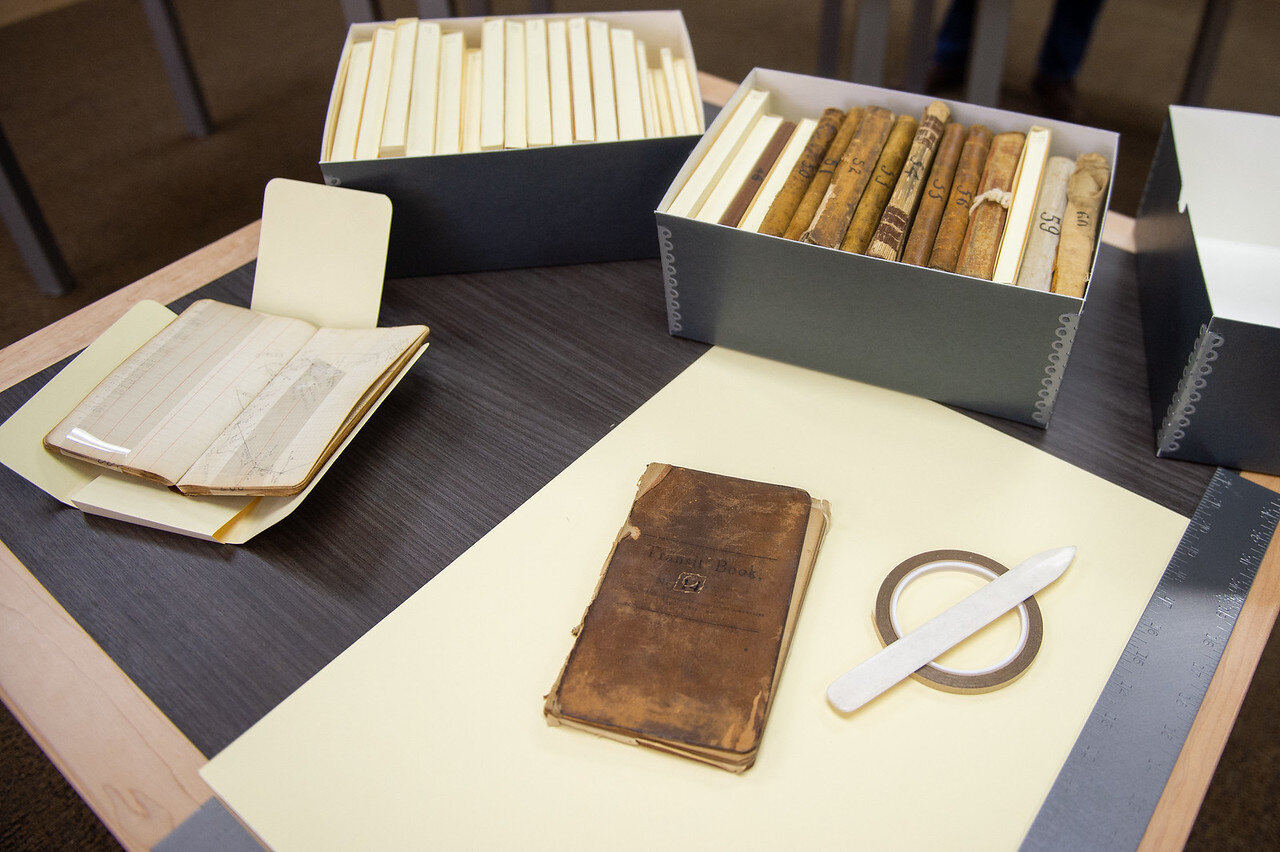
In a previous project, Conrad Blucher Institute (CBI) digitized 9,123 CBSC maps, 4,267 field books and 1,481 map page indices, which available on Bell Library’s repository. The current project will add the Family Papers to the repository.

“Special Collections and Archives preserves and shares huge collections of primary and secondary historical materials pertaining to South Texas and particularly Corpus Christi with our students, faculty, and the community – these are unique items not found anywhere else,” Atkins said. “To make them digitally available involves labor intensive, hands-on work by a team of archivists and workers. By creating an online inventory, digitizing photographs, correspondence, maps and surveying documents and making them available online, they are more widely accessible to all.”   

This project is just one of 44 made possible this year by a grant from the U.S. Institute of Museum and Library Services to the Texas State Library and Archives Commission under the provisions of the Library Services and Technology Act.

“Communities in every corner of Texas will benefit from the resources that have been made available through this list of forward-thinking grant proposals,” said TSLAC Director and Librarian Mark Smith.

TSLAC awards competitive grants annually, as funding allows. For the 2020 fiscal year, which runs from Sept. 1, 2019, to Aug. 31, 2020, TSLAC has awarded approximately $1.23 million in competitive grants. The TexTreasures Grant will provide assistance and encouragement to 12 libraries to provide access to their special or unique collections and to make information about those collections available to library users across the state, including Bell Library’s project to survey, process, and create catalog records for the von Blucher Family Papers.

Q: What is the history of the von Blucher Family Papers at Bell Library?

A: The Charles F.H. von Blucher Family Papers were generously donated to Texas A&M University-Corpus Christi by the descendants of Charles von Blucher, son of Felix Anton von Blucher (1819-1879) and Maria Augusta Imme von Blucher (1827-1893), a pioneer German couple to Corpus Christi in the late 1840s.  Foremost among these donors were Conrad Blucher and his wife Zula Blucher, George A. Blucher, Jr. and his wife Medora Blucher, Claudia Blucher Harrell, and Mary Julia Blucher Jordan.

The Blucher materials began to be transferred to Special Collections & Archives of Texas A&M University-Corpus Christi in the early 1980s. Included in these initial acquisitions were business papers as well as some of the most important, beautifully hand-drawn surveying maps of South Texas by Felix Blucher and Charles Blucher, leading surveyors of the region. Of great significance to the study of surveying and coastal studies by the university, the transfer to campus of the remaining massive Conrad Blucher Surveying Collection (CBSC), part of the Blucher Papers, was completed in 1994. 

Simultaneously, the personal and remaining business papers of the Blucher family were largely transferred to Special Collections during the 1990s but culminated in 2012 with the final significant addition. Complementing the CBSC, these items comprise one of the most important sources in Texas for studying the acculturation and contributions of German-Americans and span from the 1840s-1950s.

Drawing from the personal papers, the award-winning book of correspondence entitled “Maria von Blucher’s Corpus Christi:  Letters from the South Texas Frontier, 1849-1879” edited by Bruce S. Cheeseman was published in 2002. Other publications have emanated from the Blucher Papers as well. Many more works will doubtless be produced as access to the collection expands and scholars increasingly focus their attention to the vast range of ethnic diversity in South Texas.

- Dr. Tom Kreneck, Past Director of Special Collections and Archives at Bell Library

TAMU-CC COVID-19 Researchers Urge Caution During Labor Day Weekend

2020_pandemic-report-story_web-story_800x500.jpg

CORPUS CHRISTI, Texas – With the Labor Day weekend approaching, researchers at Texas A&M University-Corpus Christi are hoping residents and visitors will avoid the types of large gatherings during Memorial Day that contributed to a surge in COVID-19 cases.

“Now is not the time to let down our guard,” said Dr. Philippe Tissot, interim director of the Conrad Blucher Institute. Tissot leads a special COVID-19 task force that is tracking numerous sources of data to develop models designed to help leaders and the community understand how the virus is spreading. While some of the data is showing downward trends, researchers are concerned that a lapse in social distancing and other precautions during the Sept. 5-7 Labor Day weekend could recharge the rate of transmission of the virus.

“We’re hoping that Labor Day does not kick off an outbreak the way that Memorial Day did,” said task force member Dr. Chris Bird, Associate Professor of Biology at Texas A&M-Corpus Christi.

Data shows new COVID-19 cases steadily climbed in the weeks after Memorial Day from just a handful per day to more than 50 per day per 100,000 people in Nueces County. That trend was mirrored in neighboring counties and across the state.

“We were seeing significant increases all across Texas for much of June and July,” Bird said.

Soon after, the hospitalization rate also jumped, which included significant numbers of people in intensive care units. Not long after, an increase in fatalities followed. Eventually, the increase in numbers of new cases and hospitalizations began to level off, then begin what appears to be a slow decline.

“It has only been in the past few weeks that we have seen encouraging signs that we’re moving in the right direction as a state,” Bird said. “We have to remember that while the numbers appear to be dropping, there is still a long way to go to get back to the levels of new cases and hospitalizations we were seeing before Memorial Day. This is no time to relax or become complacent about following COVID-19 precautions.”

The task force members attribute the trend downward in some part to a greater awareness of the importance of social distancing and following precautions, such as regular handwashing, a commitment to wearing face coverings, not gathering in groups, and staying at home whenever possible.

“We have shown that by changing our behavior, wearing masks, social distancing, and other precautions we can make a difference in the transmission rate of this terrible virus,” Tissot said. “Now let’s show that we can maintain those safe practices through this upcoming holiday weekend and continue our downward trend.”

Bird and other members of the task force are preparing in-depth reports and public presentations each week for the City of Corpus Christi and Nueces County that model the course of the virus across the Coastal Bend. The updates had been presented on Fridays since April, but are now being presented on Tuesdays at 5 p.m.

The team’s presentations and findings can be seen on a special dashboard: https://www.conradblucherinstitute.org/covid19.

Texas A&M-Corpus Christi and Del Mar College Part of New $20 Million National Artificial Intelligence Research Institute

By Luisa Buttler, Del Mar College, Contributed Content

CORPUS CHRISTI, Texas – Hailed as a “historic milestone in environmental science,” the National Science Foundation (NSF), in partnership with seven other federal agencies, has announced an overall investment of more than $100 million to establish seven inaugural national centers across the nation to further explore how to best develop Artificial Intelligence (AI) to benefit our society.

Collaborators include Texas A&M University-Corpus Christi (TAMU-CC) and Del Mar College (DMC), which are part of a unique partnership headed by the University of Oklahoma (OU) that will investigate how to enable rapid integration of trustworthy AI for increased societal impact.

Dr. Amy McGovern, OU professor, leads the NSF AI Institute for Research on Trustworthy AI in Weather, Climate, and Coastal Oceanography, which received $20 million of the NSF funding. The partnership is made of multiple academic institutions, two national laboratories, and private industry partners including Google, IBM, and NVIDIA.

“This institute is a convergent center that will create trustworthy AI for environmental science, revolutionize prediction and understanding of high-impact weather and ocean hazards, and benefit society by protecting lives and property,” McGovern said.

In the Texas Coastal Bend, the partnership will launch a first-of-its-kind pilot AI certificate program between TAMU-CC and DMC that will teach AI to a community college audience, and broaden participation by creating a pipeline for underrepresented students in different parts of the country. Through the institute, private industry partners, along with the National Center for Atmospheric Research, internships and mentoring programs for underrepresented groups and unique workforce retraining modules will be created to engage users in learning AI for environmental applications. McGovern believes the certificate to be tested at DMC – slated to begin in fall 2021 – will soon be the first certificate for AI in geosciences in the nation.

The Coastal Bend team is led by Conrad Blucher Institute’s (CBI) interim director, Dr. Philippe Tissot, who is working in close partnership with TAMU-CC colleagues including Dr. Scott King, Computer Science Professor, along with a DMC team led by Dr. Phillip Davis, Computer Science Professor. The local team is supported by $3.2 million over the next five years.

Developing Coastal AI models using big data and satellite imagery to better predict and understand beach inundation which impacts beach goers and nesting of sea turtles will be one of the current goals of the inaugural AI center.

“The impact of mankind on our environment has continuously increased and our planet has effectively become a managed system,” Tissot said. “We must be smart, efficient, and creative if we hope to evolve towards a new balance between humankind and our earth. AI has the potential to take advantage of the large data sets now available and growing computational capabilities to help us do a better job in the face of challenges such as climate change, increase of extreme events and relative sea level rise.”

At TAMU-CC, the center will fund several graduate students, faculty, and undergraduate researchers and house DMC students participating in the research.

“Our partnership continues with TAMU-CC to develop a pipeline of GIS and remote sensing students, specifically students starting at the high school level who then move on to earn an associate’s degree from DMC as well as pursue a bachelor’s degree from the University,” said Davis, who noted that this innovative 2+2+2 program will serve as a model for other universities and colleges as the AI field grows nationwide between 2020 and 2030.

Local research will also focus on ways AI models can help better manage the environment and the economy. For example, how combining satellite imagery and numerical models to predict coastal fog will help manage ship traffic.

“The Texas Coastal Bend is thrilled to work with such a great team to bring and develop its Coastal AI expertise and create fantastic opportunities to a very diverse community, including many Hispanic and first-generation students,” said Dr. Ahmed Mahdy, TAMU-CC Vice President for Research and Innovation. “The Island University is the intellectual capital of the region. Our interdisciplinary research, like Coastal AI, is strategically unique and is a result of our innovation ecosystem.”

TAMU-CC COVID-19 Researchers See Drop in Visits to Corpus Christi After Beach-Driving Ban

CORPUS CHRISTI, Texas – Researchers at Texas A&M University-Corpus Christi are watching data that shows a parallel between beach closures and the number of people visiting the Coastal Bend.

A special COVID-19 research team is tracking and modeling data to help leaders and the community understand how the virus is spreading. The team has produced maps that show the numbers of people coming to Corpus Christi from other areas.

“The maps measure the number of times a cell phone from a non-local user goes into a restaurant” said Dr. Lucy Huang, Associate Professor at Texas A&M-Corpus Christi, who analyses cell phone app data. Each map represents one week of activity of such visits. The number of visits peaked in early June at 140,000 visits, leveled off for several weeks around 100,000 visits, then began dropping in mid-July.

The next week, just after beaches in this area were closed to vehicular traffic, the maps show a 25% decline to 70,000 visits, followed last week by another drop – to 64,000 visits.

“Overall, that’s a 36% decline from when the beach closure order was put into place,” said Dr. Chris Bird, Associate Professor of Biology at A&M-Corpus Christi. Bird noted that people who usually come here knowing they can drive right onto the beach may have changed their plans upon hearing of beach closures to vehicular traffic, and decided to go elsewhere. “I suspect that there is some deterrence in people coming to the Coastal Bend for vacation because of that beach closure.”

Bird gave a weekly update Friday, Aug. 7, to the community on the data being tracked and modeled by the task force, which started its work in April. Closing beaches to vehicular traffic is one method of attempting to control spread of the virus by discouraging visitors from elsewhere.

The maps of visits have been prepared since Memorial Day weekend. The latest map, with 64,000 visits, is the lowest number seen so far. The maps also show the percentages of visitors from various cities. San Antonio regularly leads in visits to Corpus Christi, varying from 15% to 26% of all visitors. Others come from just about every part of Texas, with significant percentages on most maps from Houston, Austin, and Georgetown, Texas.

“Are there other reasons why this number declined?” Bird said. “Probably, but it seems that the beach closure is correlated, at the very least, with this decline in the number of visits.”

Among other information researchers are tracking is cell phone data that measures the number of visits to parks, museums, and the beach. Starting in early May, beach traffic began to increase, more than doubling by the middle of June. Beach traffic then began to slow until mid-July, when it began a sharp decline back to levels not seen since mid-May.

The team emphasized that while the beach itself may not be a particularly likely location for someone to contract the virus, when a visitor comes to visit the beach, they also visit other areas and businesses.

“Sure, the beaches are outdoors and therefore of a lesser risk, but there is everything else that is associated with a visit, such as restaurants, service stations, hotels, all making indoor gatherings likely,” said Dr. Philippe Tissot, Interim Director of the Conrad Blucher Institute at A&M-Corpus Christi.

The update from the task force showed that the number of cases across the Coastal Bend has now surpassed 14,000. The task force has seen the number of new cases per day reach a peak and start a slow decline, although the Coastal Bend still has one of the highest rates of new cases per capita when compared to the rest of the state. Data shows 7,811 people in the Coastal Bend have recovered from the virus.

The researchers urge people to follow precautions carefully, such as social distancing, hand-washing, wearing face coverings, staying at home, and not gathering in groups in an effort to slow the spread of COVID-19.

The task force also recommends being particularly careful about attending family gatherings with relatives one may not see every day. The public is especially cautioned to avoid contacts with older members of their families.

Tissot, Bird and other members of the task force are preparing in-depth reports and public presentations each week for the City of Corpus Christi and Nueces County that model the course of the virus across the Coastal Bend.

The team’s presentations and findings can be seen on a special dashboard: https://www.conradblucherinstitute.org/covid19.

Blucher Institute researchers taking a deep dive into Hanna - KRIS6 News

Conrad Blucher Institute researchers were interviewed by KRIS 6 News - Corpus Christi on August 11, 2020 about the impacts of hurricane Hanna and how we can use data from the storm to better prepare for the future. See the video and article below, or click here to see it on the KRIS 6 website.

TAMU-CC Researchers Urge Continued Caution Despite Peak in COVID-19 Cases, Hospitalizations

2020_pandemic-report-story_web-story_800x500.jpg

CORPUS CHRISTI, Texas – Researchers at Texas A&M University-Corpus Christi are watching data that shows a hopeful peak in the number of cases of COVID-19 as well as the number of hospitalizations and people in the ICU, but warn that now is not the time to let down our guard.

“We peaked in cases, we peaked in total hospitalizations, we are peaking in the numbers of people in the ICU, and fatalities,” said Dr. Chris Bird, Associate Professor of Biology at Texas A&M-Corpus Christi. Bird gave a weekly update Friday, July 31, on the data being tracked and modeled by a special task force.

However, Bird is concerned by other data that shows a slowdown in social distancing, measured by cell phone encounters. He noted that cell phone encounters were dropping during recent weeks but now appear to have leveled off or started to increase.

“It’s important that we don’t let up now,” he said. “It’s looking like cabin fever, apathy, boredom, or just being tired of it is setting in.”

Other models updated in Bird’s report showed there have been more than 12,000 reported cases in the Coastal Bend since March, with more than 6,100 active cases. The research team is following the Centers for Disease Control estimate that about 10 times more cases are active than the number who test positive, giving the Coastal Bend an estimated 60,000 cases or more. That translates to one in 10 people in the community are infected.

Bird said while South Texas still leads all other areas of the state in the number of new cases per day per 100,000 people, the number of new cases appears to be declining. But because the numbers are so high in most categories, even a downturn does not mean precautions can be ignored.

“Because there are just so many people who have COVID now, just a little change in behavior, just wearing masks a little less, distancing a little less, has a much bigger impact now than it would have had in March, April and May,” said Dr. Philippe Tissot, Interim Director of the Conrad Blucher Institute at A&M-Corpus Christi.

The researchers urge people in the community to commit themselves to carefully following precautions, such as social distancing, hand-washing, wearing face coverings, staying at home, and not gathering in groups in an effort to slow the spread of COVID-19.

The task force also recommends being particularly careful about attending family gatherings with relatives one may not see every day, including funerals, baby showers, weddings, and other family events. The public is especially cautioned to avoid contacts with older members of their families.

Tissot, Bird and other members of the special task force are preparing in-depth reports and public presentations each week for the City of Corpus Christi and Nueces County that model the course of the virus across the Coastal Bend.

The team’s presentations and findings can be seen on a special dashboard: https://www.conradblucherinstitute.org/covid19.

CBI in the Field After Hurricane Hanna

Beginning Wednesday, July 29th, Conrad Blucher Institute for Surveying Science began the first of several field campaigns to the survey the the damage along the Texas coast from Hurricane Hanna. The field operations crew from the Conrad Blucher Institute for Surveying Science and the Measurement ANalyTIcS (MANTIS) Lab are working together to collect UAS and mobile lidar data for the City of Corpus Christi and Nueces County. The UAS and mobile lidar data collected can be processed to generate high resolution (2 cm accuracy) interpolations of the post-storm ground surfaces. Presently, survey priority has been given to the beach between the horse path (south of Access Road 6) and Packery Channel (see map in photo gallery). With beach access points damaged by the hurricane, especially in more remote locations, UAS data will be paramount in aiding city planners as they assess the damage from the recent hurricane. This data will also help inform their decisions for repairing and rebuilding in the wake of Hurricane Hanna.

Weathering Environmental Change Through Advances in AI

Philippe Tissot, Interim Director of the Conrad Blucher Institute for Surveying Science, collaborated with several machine learning experts in the EOS (Earth and space science news and analysis) article Weathering Environmental Change Through Advances in AI. The article discusses convergent multisector research which may improve AI trustworthiness and, ultimately, assist decision makers.

Click to read article