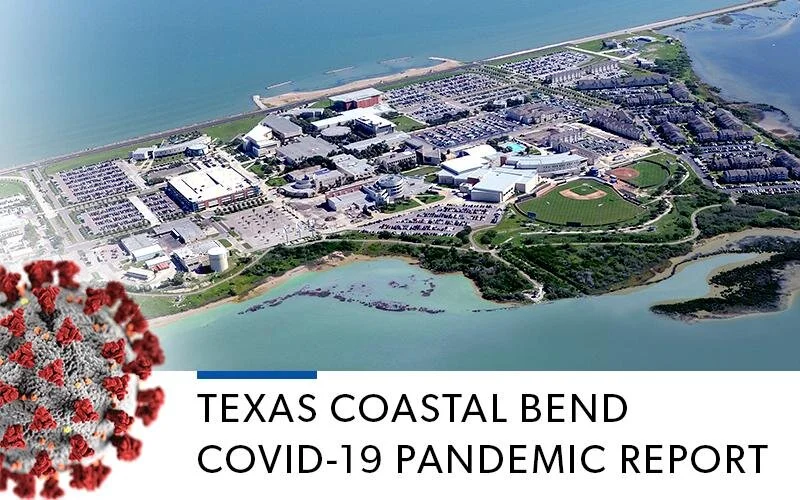
TAMU-CC Researchers Report Small Increase in COVID-19 Cases in Part Due to Increase in Testing

CORPUS CHRISTI, Texas – Researchers at Texas A&M-Corpus Christi are finding that a slight increase in new cases of COVID-19 is partially due to an increase in testing across the Coastal Bend. Other factors, including the end of stay-at-home orders and less social distancing, may be influencing the increase, they expect.

As a result, the scientists calculated a slightly higher predicted transmission rate for South Texas, which is still far less severe than if current precautions were not being followed. However, the new rate is set at 1.5 people infected per carrier, indicating that the infection is likely spreading, even if slowly. The updates came as the research team, part of a joint taskforce, gave its weekly presentation today to Corpus Christi City and Nueces County leaders.

In his presentation, Dr. Chris Bird, Associate Professor of Biology, noted that there are now three times as many cases per capita in Bexar County as in Nueces County, which is important considering the number of people who typically travel between the two counties and the resulting increased risk of virus transmission. Data presented at the meeting also showed a slight increase in cases per day in Nueces County while the rest of the Coastal Bend had not seen a clear increase.

As during past presentations, the researchers showed three scenarios that predicted the outcomes if various levels of preventative measures were taken, with a second wave of COVID-19 infection anticipated if all precautions are ended, and lesser levels of infection predicted depending on less stringent protective measures.

Their study of social distancing practices, based on cell phone data, showed that a small increase continues in the number of encounters between people since before the stay-at-home order ended. The cell phone data, which cannot be traced back to individual users, illustrates the daily number of human-human contacts outside of the home.

The researchers outlined several steps that can be taken to limit individuals’ exposure to the virus and help reduce the possibility of transmission to others. They include wearing a mask as recommended by the Centers for Disease Control; self-isolate when experiencing symptoms; more testing capacity and contact tracing to identify infection and enable isolation of infectious people; the development of new treatments to mitigate the effects of COVID-19; and the possibility that summer weather conditions may help reduce transmission, although this has not yet been proven as a deterrent to this particular virus.

The team’s presentations and findings can be seen on a special dashboard: https://www.conradblucherinstitute.org/covid19.

Texas A&M-Corpus Christi Researchers Predict Outcome if Pandemic Restrictions Ease or End

CORPUS CHRISTI, Texas – As part of a joint taskforce report, researchers at Texas A&M University-Corpus Christi compared data on the COVID-19 pandemic in the Coastal Bend to data from Bexar County and elsewhere and showed the impact of easing or ending restrictions. The report was made during the researchers’ weekly presentation today to Corpus Christi City and Nueces County leaders.

In comparison to Bexar County, Harris County, and the rest of Texas, data from the Coastal Bend shows an earlier and somewhat smaller peak in COVID-19 cases. For reference, U.S. Census data shows populations of Bexar County at about 2 million, Harris County, about 4.7 million, and Nueces County, about 362,000.

“The Coastal Bend is doing well so far with the number of positive test cases continuing to decrease, including none during the past few days in Nueces County,” said Dr. Philippe Tissot, Interim Director of the Conrad Blucher Institute (CBI) at Texas A&M-Corpus Christi. “While the total number of cases is still increasing in some surrounding areas such as Bexar County, the progression appears to be linear rather than exponential, which is a very good sign.” 

Dr. Chris Bird, Associate Professor of Biology, explained the project and discussed the major differences between three scenarios scientists looked at in their study: continue restrictions currently in place; ease some restrictions; or remove all restrictions.

“We predict that keeping the present Stay-at-Home measures keeps the number of infections low and under control for the foreseeable future, the next couple of months,” Bird said. “Lifting all restrictions leads to a surge in the number of infections and the overwhelming of our hospital infrastructure. The middle scenario shows what happens when Stay-at-Home is ended on April 30. The overall goal is to show the effect that rolling back interventions can have on COVID-19 and inspire us to find alternative ways of reducing the rate of transmissions, such as wearing face masks in public.” 

Another factor being considered by the team is the “seasonality” of the virus, defined as the potential change in the spread of the epidemic due to seasonal changes in temperature and humidity.

“Last week we decreased the transmission rate by 20% in the summer based upon a study by Harvard University that determined a 20% seasonal effect was a moderate estimate given what is known about other coronaviruses and flu,” Bird said.

The team also is measuring the effectiveness of social distancing by looking at cell phone data. Because social distancing is such a critical part of preventing the virus from spreading from one person to another, A&M-Corpus Christi scientists are experimenting with a new tool to quantify social distancing in Corpus Christi and provide better information to decision makers.

“The data is based on daily information gathered from a portion of cell phone users and estimates how often people meet other people who are not part of their household,” Tissot said. “More specifically, it counts when two devices are within 50 meters for less than 60 minutes.”

The data, which cannot be traced back to individual users, shows how the daily number of human-human contacts outside of the home decreased dramatically between normal levels in February through the present Stay-at-Home order, estimated as about an 80% decrease due to the mitigation measures.

The team’s presentations and findings can be seen on a special dashboard: https://www.conradblucherinstitute.org/covid19.

In addition to Tissot and Bird, the A&M-Corpus Christi team includes Dr. Lucy Huang, Associate Professor of Geographic Information Science and coordinator of the Geospatial Systems Engineering Program in the Department of Computer Sciences; and Marine Biology Ph.D. candidate Jason Selwyn as lead modelers for the taskforce. Many others are gathering and verifying information, building the information pipeline, and developing the dashboards that provide the information to the public.

Faculty and researchers from CBI, the Life Sciences and Computer Sciences departments and the College of Nursing and Health Sciences form the core of the team as it collaborates with staff at the city, county, and local hospitals.

TAMU-CC Teams up with City, County to Provide Models to Predict Pandemic’s Path in the Coastal Bend

CORPUS CHRISTI, Texas – A joint team from Texas A&M University-Corpus Christi, the City of Corpus Christi, and Nueces County has developed three models that can predict the number of cases of COVID-19 in the Coastal Bend and the impact on local hospitals, depending on mitigation measures, how well they are followed, and the characteristics of the local population.

At the meeting of the Corpus Christi City Council Friday, the team shared the models along with predictions for the next three to four months based on the information they presently have. They will continue to improve the models based on new information.

Dr. Chris Bird, Associate Professor of Biology, explained the project and discussed the large differences between a scenario without precaution and one that follows the present measures.

“We would be facing hundreds of COVID-19 deaths in the coming few weeks if we were not taking these steps,” said Bird, who typically studies molecular genomics to advance understanding of marine species and promote the sustainability of marine ecosystems.

The models outline three scenarios: what would be happening if social distancing and stay-at-home orders had not been put in place; what would happen if such orders were ended today; and what would happen if these measures stay in place and are followed by the public.

Results between the first two scenarios were somewhat similar but showed a big difference if social distancing and stay-at-home orders stayed in place. One graphic presented at the meeting showed that if no measures had been taken, the Coastal Bend would have as many as 300,000 cases of COVID-19 by mid-April. If measures ended today, the Coastal Bend still could see up to 200,000 cases by mid-May. If measures continue, a peak in cases could be delayed until late May with an estimate of 10,000-87,000 cases.

“It does show some pretty dramatic impacts of how, by us following the orders that have been put in place of social distancing and staying at home, why it matters,” Corpus Christi City Manager Peter Zanoni said. The city approached University leaders President Kelly M. Miller and Vice President for Research and Innovation Ahmed Mahdy last week for help in studying the situation and creating the models.

“It was without hesitation that they assembled a team of research scientists to help our community better understand and project COVID-19 infections and the impact they would have on our regional medical facilities,” Zanoni said.

The team studied transmission ratios across Texas to make predictions about how rapidly the virus would spread here.

“Pandemics are very rare but this is also why it is difficult for all of us to come to grasp with how quickly things can evolve,” said Dr. Philippe Tissot, Interim Director of the Conrad Blucher Institute (CBI) at Texas A&M-Corpus Christi. “At the start of the epidemic, using the analogy of a fire, you go from a few community brush fires, to before you know it, within weeks, a full forest fire.”

Tissot said this “forest fire effect” is what has happened in places such as Wuhan, China, Italy or New York City. For the Coastal Bend, initially, it will be more a matter of anticipating what is yet to come.

“The models’ projections and visuals provide the public comparisons of what can happen very quickly if we do not apply strong mitigation measures,” Tissot said. “The graphics provide a comparison of where we would be heading without the mitigation measures that our state, county, and city took. The models also allow us to test different strategies and will allow our decision makers to compare options while considering other factors such as likely economic impact.”

Tissot noted that instead of spending a lot of time creating models from scratch, the researchers looked at existing models that could be used for this purpose.

“Predictions were needed as soon as possible and there were good open-source, vetted options available,” Tissot said. “The team reviewed existing models that were already used to predict the COVID-19 impact including the ones used by the White House. The team selected three models that could be adapted to the Coastal Bend.”

The team is combining data about the virus and from other places where the pandemic has had a greater effect with data from the Coastal Bend. The team also will compare predictions of these three models with two different models being run by others for the full state of Texas.

Tissot said the process can be compared to hurricane predictions.

“The three models have different assumptions and mechanics and give us a better idea of what will happen, a little bit like the spaghetti diagrams predicting a hurricane’s path,” Tissot said. “Also, this is a new virus that we are constantly learning more about. While the virus is the same everywhere, it will propagate differently in New York, Italy, and China as compared to the Coastal Bend. We need to take that into account and learn from the developing local data.”

Tissot said an important component of the process is the collection and flow of information from the hospitals and the testing labs.

“The city, county, and individual hospitals have started to provide this crucial information and we are building with them this information pipeline that will feed the models,” he said. “The team is also working on dashboards similar to the one already provided by the university to track the pandemic in Texas (https://www.conradblucherinstitute.org/covid19).”

The A&M-Corpus Christi team includes Dr. Chris Bird, Associate Professor of Biology; Dr. Lucy Huang, Associate Professor of Geographic Information Science and coordinator of the Geospatial Systems Engineering Program in the Department of Computer Sciences; and Marine Biology Ph.D. candidate Jason Selwyn as lead modelers for the taskforce. Many others are gathering and verifying information, building the information pipeline, and developing the eventual dashboards that will provide the information to the public.

Faculty and researchers from CBI, the Life Sciences and Computer Sciences departments and the College of Nursing and Health Sciences form the core of the team as it collaborates with staff at the city, county, and local hospitals. Ph.D. students Evan Krell and Mahmoud Eldefrawy are working with Dr. Scott King, chair of the Computer Sciences Department, to automate the data flow processes. CBI undergraduate research assistant Audrey Garza is helping gather and process data. Others in the health care community are also lending their expertise, including Mike Mohat, Senior Director for Emergency/Intensive Services at Driscoll Children’s Hospital.

While the researchers at CBI and elsewhere across the university are currently applying their unique skills to this crisis situation, CBI normally focuses on coastal monitoring, mapping shorelines for beach erosion studies, oceanic/atmospheric predictions, and other related research. They also work to provide for the unique needs of Texas surveyors by developing strong continuing education and research programs in GIS and Geomatics.

To see a copy of the full presentation given on April 10, 2020, visit https://www.tamucc.edu/assets/covid-19-taskforce-presentation04102020.pdf.

TAMU-CC Conrad Blucher Institute Maps COVID-19 Spread

CORPUS CHRISTI, Texas – The Conrad Blucher Institute at Texas A&M University-Corpus Christi is mapping the spread of the COVID-19 pandemic in Texas and around the Coastal Bend. The maps represent information confirmed by the Texas Department of State Health Services.

“My colleagues Bryan Gillis and Dr. Lucy Huang have created sophisticated yet relatively simple and informative maps and dashboards to follow the COVID-19 progression,” said Dr. Philippe Tissot, interim director of the Conrad Blucher Institute (CBI).

Data is being provided in two formats: an interactive GIS dashboard and downloadable static maps, which are posted daily on the institute’s Facebook page.

Tissot said CBI is committed to providing relevant and accurate information to the public in informative and interactive formats.

“Geospatial information is a critical component in epidemiology,” said Texas A&M-Corpus Christi researcher Dr. Yuxia “Lucy” Huang, Associate Professor of Geographic Information Science and coordinator of the Geospatial Systems Engineering Program in the Department of Computer Sciences. “Maps visualize the spatial distribution of cases over space and time. Mapping diseases helps the public understand how the diseases are spread out, particularly around the area they are interested in.”

The public wants to know where high concentrations of the outbreak are and how close they are to hotspots. Maps can answer these questions, Huang said.

Huang said the team started by investigating existing dashboard products that were tracking COVID-19 in real time.

“Since we did not find any that focus on Texas, we decided to build one,” she said.

Presenting data in the form of a map gives readers the ability to quickly understand complex spatial patterns, said Bryan Gillis, Research Specialist at CBI. “In this situation, it’s common knowledge that the outbreak would be worst in urban environments but the spread along interstate corridors showed how continuing travel caused the virus to creep into smaller communities.”

Readers can quickly find their county on the maps, but at the same time seeing it on a map gives them greater context to what is happening around them, Gillis said.

“Take Kleberg County for example. They had zero confirmed cases (as of March 26), but just next door, Nueces County had 15 (as of March 26), and it’s known that many people commute between these two areas daily,” Gillis said. “So even if there is no outbreak in your area, you can anticipate the threat from a more realistic view.”

The experts said as the COVID-19 situation grew, the CBI team began investigating how they could efficiently and effectively provide information to the public. It started with a simple map showing ISD closures across Texas. Within a day, all ISDs were closed and they switched gears to mapping COVID-19 cases. The next day they were tracking new cases along with total cases because they felt it gave a greater picture of the worsening situation.

“Our biggest concern was ensuring our data was accurate and timely, because if we were going to publish time-critical information to the public we needed to be fully committed,” Gillis said.

One Island University student worker is assisting Huang to update time series data daily. Audrey Garza is a weather and atmospheric science major and geographic information science minor. Garza has been involved in several CBI projects.

As the group posts maps on social media, they are receiving a tremendous amount of feedback.

“We are receiving thousands of engagements on Facebook every day,” Gillis said. “We also see quite a few questions each day about the data and why State level data is different than local authorities. Because the State is going through a thorough vetting process of test results, we can say with certainty that a result is a true positive.”

Gillis said that doesn’t mean the data is perfect, and at times confirmed cases are reassigned to different counties once residency information is confirmed.

“The reason we class cases by residency instead of where they are being treated is your place of residency is where the case likely came from, not necessarily where you were tested or treated.”

The CBI team will continue to publish static maps daily and maintain the COVID-19 dashboard through the declared end of the outbreak. At the end of this crisis they will also convert all of their collected data for public use and scientific research.

The maps and dashboard only reflect official State of Texas data so the public is asked to continue to monitor updates and reports from local authorities for the most up-to-date and relevant information.

CBI Researcher Studies Individual Vulnerability to Communicable Diseases

By Darrell Pehr 

A study published by Texas A&M University-Corpus Christi researcher Dr. Yuxia “Lucy” Huang in 2012 shows striking similarities to today’s health crisis surrounding the COVID-19 pandemic.

Huang was joined by scientists from New York, Florida, Maryland, Georgia, the National Institutes of Health and South Korea in the study, which looked at how communicable diseases are transmitted from individual to individual following a network of contacts in a population. The study focused on dangerous communicable diseases, particularly severe acute respiratory syndrome (SARS) and H1N1 flu.

“The role of individuals in the spread of these diseases is critical,” said Huang, Associate Professor of Geographic Information Science and coordinator of the Geospatial Systems Engineering Program in the Department of Computer Sciences. Huang, who came to Texas A&M-Corpus Christi in 2008, also is a research scientist in the Conrad Blucher Institute for Surveying and Science.

The study examined who might be at risk, where and when the risk occurs, and with whom these at-risk individuals might be in contact. The findings were then used in the development of health policies to control and prevent the spread of diseases, based on different scenarios.

The study simulated the population using Census data. It looked at where people would be during three times each day: daytime, pastime and nighttime. Location also was considered, whether at home, at a workplace, or at another location, such as a shopping mall or church. It also considered weekend behaviors, with the goal of mimicking the actual situation as much as possible.

“You need to build up this social network to figure out who contacts whom, where and when. That’s the critical part,” Huang said, “so we can know who are at risk, and when and where those people may be at risk of becoming infected. Because the study was based on individuals’ behaviors, we can check each person’s trajectory.” The study also looked at how likely each person was to become infected.

Huang agrees with the steps that have been taken with the COVID-19 epidemic.

The study noted that transmission of communicable diseases depends on three considerations: the contact of susceptible individuals with an infectious individual, the infection probability of these susceptible individuals, and the types of protective actions they take once they develop symptoms.

“If people practice social distancing, it will help prevent the disease from spreading,” she said. With family members living in China, Huang has seen how a population under pressure from a rapidly spreading disease can take action to slow its progress. Her brother and parents live in China, and endured long periods of quarantine as the country weathered the illness.

Taking steps to limit person-to-person contact is just as important in this country, and Huang feels the University is well-prepared for a transition away from face-to-face classes.

“The University provides fantastic support for faculty through the Office of Distance Education and Learning Technology for online teaching,” Huang said. “The resources are great.” Huang is a member of a campus committee that meets regularly to offer support for faculty members and offer strategies for successful online education.

United Nations and Conrad Blucher Institute: UAS for Sustainability and Resiliency

As part of the United Nations Global Geospatial Information Management section, CBI researchers Dr. Michael Starek, Ms. Melanie Gingras, and Dr. Gary Jeffress developed an application procedure for coastal monitoring to aid community resiliency using unmanned aircraft systems. The procedure outlined in their chapter can be applied to global efforts such as “Life of Land” which focuses on sustainable land use and “Zero Hunger” which aims to improve sustainable agricultural practices and crop security in developing nations. Read their chapter here.

UN UAS.jpg

Dr. Starek and Ms. Gingras continue to push the boundaries of UAS applications as they develop new procedures for environmental applications that include height modernization, marsh classification, coastal dune protections, and flood management.

1919 Hurricane Demonstrates how Past Speaks to Present

CORPUS CHRISTI, Texas – To commemorate the 1919 Hurricane that ravaged the coastal city of Corpus Christi and claimed as many as 1,000 lives, the Texas A&M University-Corpus Christi Historical Forum along with the Mary and Jeff Bell Library hosted “100 Years After the Storm” on Friday, Sept. 13. The program, which was part of “Remember the Hurricane of 1919: 100 Year Anniversary,” featured guest speaker Mary Jo O’Rear, an Islander alumna, author, and historian along with a panel discussion led by faculty experts Dr. Lisa Comparini, Dr. Dan Jorgensen, Dr. Philippe Tissot; and Dr. Patrick Fitzpatrick acted as moderator.  

“It was a shocker. Everyone in Aransas Pass, Rockport, and Corpus Christi thought that we were in a safe haven, but the 1919 Hurricane was a catastrophe that hit the whole Coastal Bend,” said O’Rear in her keynote address.

During the program, O’Rear spoke on the attitudes and myths surrounding hurricanes in the Gulf Coast in the early 1900s. According to her book, “Storm Over the Bay: The People of Corpus Christi and Their Port,” Coastal Bend residents living at that time felt immune to the devastating forces that threatened the Texas coast after remaining unscathed by hurricanes that severely affected Galveston and Harbor Island in 1915 and 1916.

 “As scientists, we can give numbers, maps, and charts but curating stories of people who went through those events speak a lot more,” said Tissot, Conrad Blucher Institute Interim Director and Associate Research Professor at Texas A&M-Corpus Christi. “The books we discussed will allow people to better relate with how horrible these experiences were and realize they don’t want to be in the paths of storms like these.”

Before hearing an excerpt from O’Rear’s book, the panel discussed topics that ranged from emergency management and federal government intervention, to the tools and resources that are available to predict weather scenarios. Most importantly, the panel touched on mindsets that parallel the attitudes and myths in previous century.

“Constantly, there’s a push to say that we’re safer than we really are,” Tissot said. “I don’t know if it will happen in my lifetime, but there will be other big storms hitting Corpus Christi. The key is to constantly prepare yourself, have a plan and follow directions. Also keep in mind the saying ‘Hide from the wind, run from the water!’’”

Those wanting to learn more about the 1919 Hurricane  can visit the unique photos and artifacts in the Special Collections and Archives of the Mary and Jeff Bell Library.

Red River Boundary Survey 2019

June 18-20, 2019

The first ever field course based on retracing original boundaries along the Red River in northeast Texas was held during the summer of 2019. The research started with an original boundary corner set by appointed Commissioners under the authority of the 1923 Oklahoma v. Texas Supreme Court Decision. Land surveying education at Texas A&M University-Corpus Christi is unmatched through applicable experiences directed by experienced instructors.

2019 FIELD CAMP COURSE DESCRIPTION

The Geographic Information Systems baccalaureate program in Land Surveying at Texas A&M University – Corpus Christi with support of the Conrad Blucher Institute for Surveying and Science was pleased to announce a new elective course for our students where they received exposure to riparian boundary surveying along the Red River in Red River County, Texas. This course consisted of a week of riparian court cases review. It also exposed our students to field exercises retracing historic avulsion boundaries established by the Commissioners of the Oklahoma v. Texas Supreme Court and application of the gradient boundary method and 2000 Red River Boundary Compact along the Red River.

The Chapman Ranch in Red River County, Texas, hosted this year’s course. During this course, we refurbished a 95-year old wooden monument that once represented the boundary between Texas and Oklahoma which was currently in a state of decay. This was conducted as a memorial of the land surveying efforts of Author Stiles and Author Kidder, the appointed commissioners of the 1923 Oklahoma v. Texas Supreme Court and derived the gradient boundary method of determining riparian boundaries along navigable rivers in the State of Texas.

CBI’s MANTIS – New Hope in Old Appalachia

Since 2016, members of MANTIS Lab and CBI field crew have collaborated with the Apalachicola National Estuarine Research Reserve’s (ANERR) Megan Lamb for week-long field campaigns supported by National Oceanic and Atmospheric Administration’s (NOAA) subsidiary, the National Geodetic Survey (NGS). Each year, the crew gathers Terrestrial Laser Scanner (TLS) and Unmanned Aerial Systems (UAS) data for one site on the main barrier island, Saint George Island, and from several sites on “Little” Saint George Island (it is the western component of the island that was split away from Saint George Island by Bob Sike’s Government Cut in 1954). The Saint George Island site is NOAA’s Unit 4 SET site while the “Little” Saint George sites include several beach profiles (D341, R4, R41, and R29) and several historical photosites (Westpass, Bayside, and Sike’s Government Cut). This data collection is part of an NGS gulf-wide research initiative to develop and improve current Relative Sea Level Rise (RSLR) models for the gulf coast by gathering high-resolution spatial (elevation) data.

This year’s trip began May 20th and ended May 27th and included MANTIS’ director, Michael Starek, CBI’s Research Engineering Associates, Alistair Lord and Zachary Hasdorff, MANTIS Lab Manager, Melanie Gingras, and MANTIS master’s students, Jake Berryhill and Kevin Wilson. During the week, the crew used new platforms including the Wingtra WingtraOne and Phoenix Vapor 55 as well as tried-and-true platforms from previous Apalachicola field campaigns including the DJI Mavic, DJI Pantom 4, and Riegl VZ400 Terrestrial Laser Scanner (TLS). When georeferenced using RTK GPS control points, this data will generate point clouds that provide high spatial resolution data to monitor elevation changes as small as a couple centimeters as well as othomosaic imagery with pixel sizes on the order of 2cm GSD.